President Trump delivered his State of the Union address last week. It was long, and like most political speeches, it requires nuance. Rather than dissect the entire presentation, I want to focus on one specific item that matters to investors: the investment commitments secured from around the globe.
The flow of new capital is critical. When new money enters an economy and is deployed productively, it can increase economic output, improve productivity, raise wages, and ultimately support corporate earnings.
Let’s dive in.
Market Check-In
Before we turn to policy, a quick look at markets. If markets feel non-directional, you are right! The S&P500 has traded within just a 3% trading range the entire first two months of the year, or roughly 225 points. It sits flat on the year. However, under the hood and across the globe, things are quite different. Dispersion across US equities is at extreme highs. A trader’s paradise. Here is a table of year-to-date returns across the globe:
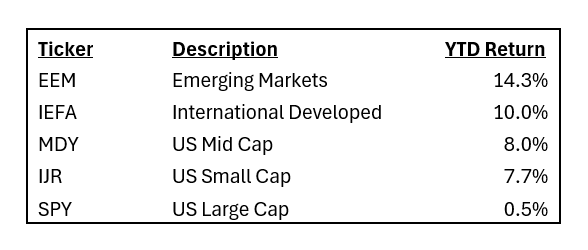
US Small caps, mid-caps, internationals, and emerging markets have enjoyed great success so far this year, while the S&P 500 is treading water. Good news for investors that own globally diversified portfolios!
Investment Commitments
Markets and economies are mostly efficient. Stock prices generally reflect known information and expectations about future earnings, but government policy can alter the environment these companies operate within. Interest rates, taxes, trade policy, and regulations all influence capital flows. One of my favorite quotes from Trump last week on financial commitments:
“In 12 months, I secured commitments for more than $18 trillion pouring in from all over the globe.” – Donald Trump, 2026 State of the Union Address
A big number, but let’s try to quantify and qualify the impact for investors. A review of the White House website shows a tally closer to $9.7 trillion. Within that number are large commitments from U.S.-based companies such as Meta, Apple, and Amazon. While important, those are domestic capital expenditures. The ones important to US investors are those called Foreign Direct Investments, which can improve a receiving country’s economy.
Strip out the U.S.-based commitments and you are left with $5.1 trillion in foreign investment commitments according to the White House. Here’s the breakdown:
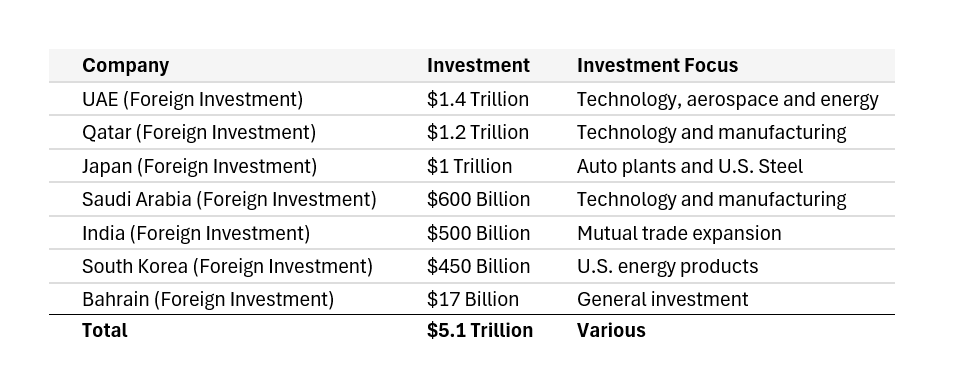
Still a substantial sum! But here’s the key: not all capital inflows are created equal.
The Multiplier Effect
For foreign investment to materially impact GDP, it must create productivity, not simply change ownership of assets. Building factories, expanding infrastructure, constructing facilities, and increasing domestic production create what economists call a multiplier effect. The multiplier reflects how one dollar spent can generate multiple dollars of economic activity.
For clarity, let’s say Japan spends their $1 trillion commitment on constructing new auto-plants across the US. A company like Vulcan Materials supplies stone, sand, and gravel to construct the plant thereby increasing their revenues. Their workers earn wages. Shareholders receive increased dividend payments. Their workers spend income in their communities. The finished plants create thousands of long-term jobs. Ongoing production generates additional output year after year.
That initial dollar investment circulates through the economy repeatedly.
For simplicity, assume a multiplier of 3x. Under that framework, $1 trillion dollars in direct investment could create $3 trillion in cumulative economic output over time. If the full $5.1 trillion were deployed into productivity-enhancing projects, the impact could be meaningful. U.S. annual GDP is approximately $30 trillion, so $5.1 trillion represents roughly 17% of annual GDP. Any multiplier effect applied to that base would be economically significant.
Consider the historical context. Here is the last twenty years of annual foreign direct investment in US.
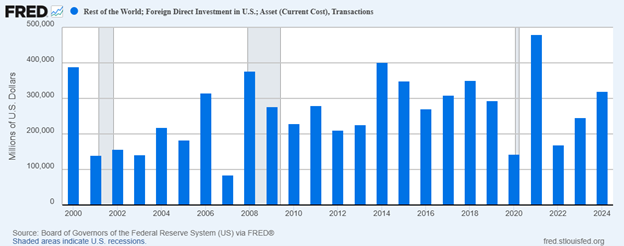
The average and median are much closer to $200 billion per year, much less than the potential $5.1 trillion secured by Trump. That’s the contrast.
But commitments are not GDP. They become GDP only when factories are built, equipment is installed, workers are hired, and supply chains are activated. However, if even a portion of the $5.1 trillion materializes as productivity-boosting investment, it would represent a multiple of typical foreign investment inflows and materially impact GDP to the positive ultimately paying investors a multiplier effect going forward!
Have a great week!
-Matt
Sources: Whitehouse.gov, Federal Reserve Bank of St. Louis, Ycharts
This communication and its contents are for informational and educational purposes only and should not be used as the sole basis for any investment decision. The information contained herein is based on publicly available sources believed to be reliable but is not a representation, expressed or implied, as to the accuracy, completeness, or correctness of said information. References to political figures or policies are for informational purposes only and do not represent an endorsement by Waddell & Associates. Any forward-looking statements reflect current opinions and assumptions and are subject to change without notice; actual results may differ materially. Past performance does not guarantee future results. Waddell & Associates may use artificial intelligence tools to help generate or summarize content; all outputs are reviewed by our team for accuracy and relevance.